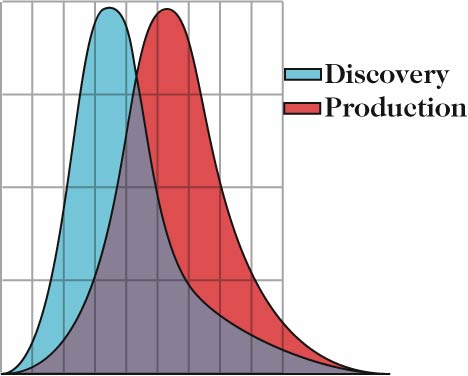
 Peak oil theory states: that any finite resource, (including oil), will have a beginning, middle, and an end of production, and at some point it will reach a level of maximum output as seen in the graph to the left. Peak oil theory states: that any finite resource, (including oil), will have a beginning, middle, and an end of production, and at some point it will reach a level of maximum output as seen in the graph to the left.
Oil production typically follows a bell shaped curve when charted on a graph, with the peak of production occurring when approximately half of the oil has been extracted. With some exceptions, this holds true for a single well, a whole field, an entire region, and presumably the world. The underlying reasons are many and beyond the scope of this primer, suffice to say that oil becomes more difficult and expensive to extract as a field ages past the mid-point of its life.
In the US for example, oil production grew steadily until 1970 and declined thereafter, regardless of market price or improved technologies.

In 1956 M. King Hubbert, a geologist for Shell Oil, predicted the peaking of US Oil production would occur in the late 1960s.
Although derided by most in the industry he was correct. He was the first to assert that oil discovery, and therefore production, would follow a bell shaped curve over its life. After his success in forecasting the US peak, this analysis became known as the Hubbert's Peak.
-
The amount of oil discovered in the US has dropped since the late 1930s.
-
40 years later, US oil production had peaked, and has fallen ever since.
World discovery of oil peaked in the 1960s, and has declined since then. If the 40 year cycle seen in the US holds true for world oil production, that puts global peak oil production, right about now; after which oil becomes less available, and more expensive.
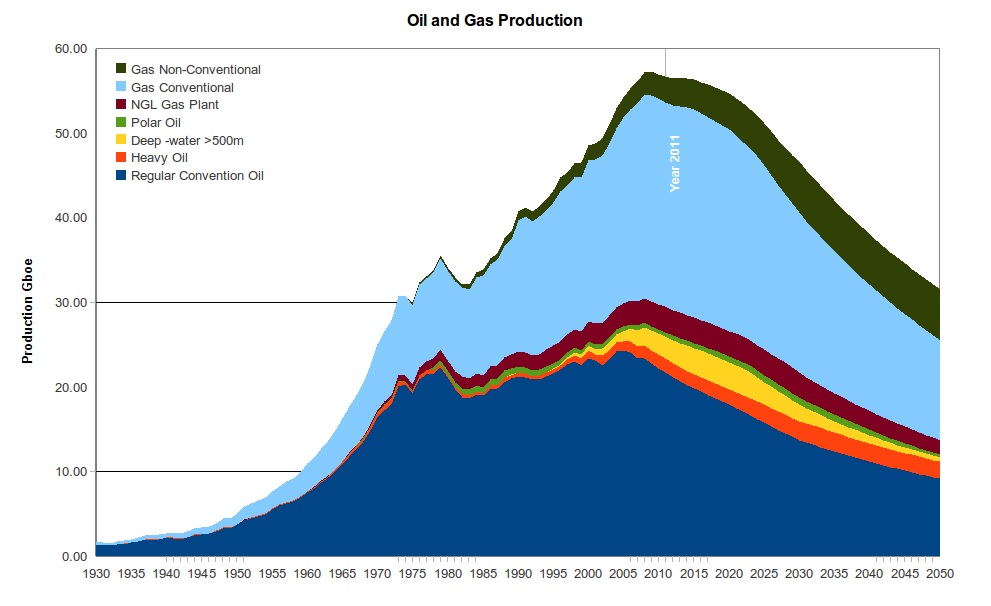
Today we consume around 4 times as much oil as we discover.
If we apply Hubbert's Peak to world oil production we estimate that approximately half of all oil that will be recovered, has been recovered, and oil production may reach a peak in the near future, or perhaps already has.
|
"Understanding depletion is simple. Think of an Irish pub. The glass starts full and ends empty. There are only so many more drinks to closing time. It's the same with oil. We have to find the bar before we can drink what is in it."
Campbell
What peaking does mean, in energy terms, is that once you've peaked, further growth in supply, is over. Peaking is generally, also, a relatively quick transition to a relatively serious decline at least on a basin by basin basis. And the issue then, is the world's biggest serious question.
Simmons
|